• About
  • Clients
  • Newsletter
  • Get in touch
  • Resumé
  • Blog
Menu

KC Orcutt

  • About
  • Clients
  • Newsletter
  • Get in touch
  • Resumé
  • Blog

#Repost UndergroundHipHop.com: Saba Levels Up: A Conversation with Chicago's Next Visionary

June 22, 2017

Watching Saba tower over his packed New York City crowd, pouring his soul out through the speakers, it’s hard not to smile. He’s clearly doing much more than making a name for himself as an emerging artist, even in the midst of insufferable loss. The 22-year-old Chicagoan from the categorically violent West Side has been dealt a rough hand. But once his fingers tighten around the mic, he triumphantly is rewriting his story, one bar at a time. 

Saba (born Tahj Malik Chandler) stands at the center of the dimly lit stage at Webster Hall on an unassuming Wednesday evening. Bursts of booming bass, laced with chants from the crowd decorate the venue walls, as Saba punctuates the ambience with lyricism trembling through half-full plastic cups of PBR. The whole scene commands all sorts of shaky-yet-determined smartphone documentation. With a vibrant assortment of curious 20-somethings and day-one devotees taking the lead songs like “Monday to Monday,” “The Billy Williams Story,” and “World in My Hands,” it was clear that these are the exact moments Saba has been chasing.

Along with his trusty affiliates and collaborators—a close-knit group of like-minded musicians known as Pivot Gang—Saba embarked on his first-ever headlining tour earlier this year: a 19-date trek scattered with boundless reaffirmations that years of hard work are finally paying off.

“I think we had a moment every night, before the show or after the show, where we’d just be looking at each other, like damn,” Saba later reflects back home at his grandparent’s house in Illinois. “Our jaw was just to the floor from being in awe, every night, in whatever random city we’d be in.”

The promotional run for his debut studio album, 2016’s Bucket List Project, turned into a movement—with bright-eyed fans swarming Saba the second he stepped off stage, hopeful to get the opportunity to talk his ear off about what’s on their own bucket list and how his music deeply resonates with them.

Much to the delight of those in attendance, Saba stuck around, happy to listen and entertain. Even the security team in New York permitted the sold-out affair to stretch well over its allotted time so grinning, sweaty fans could get their handshakes and thank yous into the single-digit hours. With the tour’s magic indisputable, reality hit once the music fades: none of this almost happened.

Two weeks prior to hitting the road in mid-February, Saba’s cousin Walter Long, Jr.—a member of Pivot Gang who released music under the monikers John Walt and dinnerwithjohn—was fatally stabbed during a fight on the street in Chicago’s River North neighborhood.

The heart-shattering news was, at first, enough to have Saba reconsidering going on the tour entirely, something he divulged to a sea of onlookers during the New York pit stop. While running through his catalog, his raw, emotional ad-libs couldn’t completely veil the fact Saba was rhyming through heartbreak. But still he pushed on, turning the piercing pain of losing a squad member into eternal motivation to continue working toward the vision they shared.

“[The tour] was the most special thing I’ve ever witnessed in my entire life, especially because of my cousin,” he somberly admits. “Walt was supposed to be on a lot of those dates with us. We were all in a really weird emotional space. But we were so blessed to be there at all.”

While the shows were full of scenes straight out of a movie that Joseph Chilliams (Saba’s older brother), MFN Melo, and Miami’s Sylvan LaCue all experienced together, the grim reality is that they haven’t been able to properly grieve through the past few months’ calamity and chaos.

“It hasn’t really processed, since we’ve been gone so much, but it’s been the most beautiful last few months of our life, and I know Walt has everything to do with that,” Saba explains. “We’re trying to get a foundation and scholarship set up. Every day is weird but we are pushing through it. We’ll make it happen one way or another.”

Following his untimely passing, Walt’s presence hasn’t dissipated. With conviction, Saba’s actions promise it never will. Leading the audience in a memoriam chant rattling louder than some of the set list’s most passionate and catchy hooks, the Pivot Gang’s visionary leader repeated Walt’s name into the microphone until his voice began to wear. While sporting his signature beanie atop his shoulder-length locs, Saba also donned a light blue denim jacket adorned with an embroidered portrait of his cousin. With the cursive words “Long Live John Walt” beautifully stitched on the back, Saba wore the custom threads with pride, carrying the reminder that those who you love never truly leave you.

“It’s so weird to even have to think like, yeah, I am keeping his legacy alive,” Saba says, his voice tender from fighting the urge to shake in disbelief. “We played basketball yesterday and that’s how he got his name, from playing ball in high school. I do very much feel his presence in everything we’re doing.”

Saba is wise to combat every heartbreaking setback hurled at him by turning to his music. Arguably, such is par for the course for those growing up in a city that has long been tied to its reputation of being plagued by senseless violence, experiencing over seven hundred murders in 2016 alone.

“Everyday somebody you know is gone, or somebody you see every day is gone,” he says. “It’s crazy difficult to be in that and to keep to yourself in hopes that things will change.”

Despite his story being lined with loss, returning to the soft-glowing optimism buried beneath his hardships is very much an integral part of Saba’s character. No stranger to receiving stomach-churning phone calls that can permanently change his world, Saba is fully aware he hasn’t had an easy ride. But he doesn’t let his tragedies constrain him, either.

“Shit is hard,” he says. “Everyday somebody you know is gone or could be gone. The amount of shit you go through living in Chicago as a young person is crazy. It’s just a place where you never know on any day what that day is going to look like, what’s gonna happen, what call you’re gonna get.”

While Pivot Gang found inspiration for its name in a classic episode of Friends (the one where Joey and Chandler help move a brand new couch up Ross’s humorously narrow stairs), the wisdom to keep moving forward was born out of a place of survival, particularly after experiencing death.

Months before Saba released his second mixtape ComfortZone in 2014, his uncle unexpectedly passed away in his sleep, doubling as a wake up call to create with intention and urgency, further proving the mantra behind their moniker is reinforced daily. When one chapter ends, another has to begin. No person or city is exempt from that, although Saba knows Chicago may be more accustomed than others.

“Chicago is the most beautiful city that I’ve ever been to,” he elaborates, not allowing his hometown’s rough edges to detract from its potential. “I think that’s the thing that a lot of outsiders don’t get. I used to have an answer in mind regarding what the city needs. It needs so much help. But I do know there are a lot of artists in the city that are changing Chicago and saving Chicago. That’s one of the things I’m most proud of.”

The fact that the days aren’t promised was further augmented at the top of this year, when Walt called him to reveal that he survived an entire clip being emptied into the side of a car he was in. Such gut-wrenching events are etched into the increasingly common picture of what it’s like to grow up in Chicago. Knowing this all too well, Saba leaves himself no choice but to keep his inner turmoil at bay and look toward the light. This very concept is etched into every song on the Bucket List Project, and is one he keeps close to his chest.

Navigating through a path littered with the uncertainty that life’s next cruel plot twist could be lurking around the corner, Saba’s courageous perspective is lauding him as one of Chicago’s most promising upstarts. From performing at open mics in Wicker Park as a teen to gracing the stage of the Late Show with Stephen Colbert in 2015 alongside Chance the Rapper, the growth that he has experienced is an inspiration.

Such unfiltered tenacity shines through his catalog, and in embracing his story over a refreshingly eccentric neo-soul-meets-rap-inspired soundscape, he’s winning over a widespread audience. In 2013, his first collaboration with Chance the Rapper, “Everybody’s Something,” helped elevate him to a new level—with eyes fixating on Chicago’s prospering rap scene in ways they haven’t since artists such as Kanye West, Common and Lupe Fiasco first put on for the city and garnered national attention. After collaborating with artists such as Mick Jenkins, Taylor Bennett and Eryn Allen Kane, Saba reunited with Chance, creating 2015’s “Angels”—a track that has since seen over 70 million streams on Spotify.

“Every year has been better than the last,” he exclaims. “Making beats for my brother and his friends when I was 13 was one thing, but I had to really step my game up. Now everybody is still trying to out-rap everybody, but those early competitions had a huge effect on what my everyday life is like now.”

From Chi-town legend Twista to industry mainstay Sway Calloway rooting for him, Saba’s new normal includes Chance showing up as a surprise guest during his most recent headlining set, seeing his name selected for The Source’s coveted Unsigned Hype column and landing a nomination for XXL’s 2017 Freshman Class. Despite this growing list of accolades, Saba is trying his best not to get his mentor, FRSH Waters, too excited.

With their friendship dating back to when Saba was 13, FRSH helped put Pivot Gang on the map over five years ago, even guiding Saba to the right rooms to introduce him to Chance and Noname. After getting into some legal trouble, FRSH has since assumed the temporary role of being the group’s unofficial head coach, offering sage advice from behind bars.

“It’s been kind of crazy because he hasn’t been able to see what something he started has turned into,” Saba says. “We try to downplay everything so he doesn’t feel like he’s missing out on too much.”

With more people to make proud than just himself, Saba’s optimistic spirit is taking charge. As he rises as Pivot Gang’s rightful leader, it’s hard not to see how his path mirrors that of Chance’s, whose ascent to stardom stemmed from his early work with his former Save Money crew alongside Vic Mensa.

Although the Pivot Gang has been home basking in their recent triumphs, they haven’t slowed down. A tireless Saba is no exception, performing an assortment of one-off shows at various colleges and already diving headfirst into his next studio effort. His hunger is also presenting him with options for his first real apartment, with the support of his loyal legion of fans affording him the luxury of being able to leave his childhood home.

“I’ve never moved in my entire life so this will be a big deal,” he says modestly. “I’m so excited to have my own thing. I’m trying to make sure I have at least two bedrooms, one for my bed and I want to have a studio in the other room, so we’ll see how that goes.”

His preferences for where he wants to live are strikingly minimalistic, such as requesting natural light and solid neighborhood food options. True to form, Saba’s priorities lie within his music.

“I built the studio in my basement now, and it’s been down there for years and years and years,” he says, detailing his plans for his new studio. “I’m excited to start from scratch and see what it turns into over time.”

While going through what accumulated in the same studio he recorded his first project, 2012’s GETCOMFORTable, Saba struck gold. During the coming-of-age cleaning process, he unearthed a dust-covered box full of cassettes he recorded when he was a young boy.

“I haven’t even listened to them yet because I don’t have a cassette player,” he says. “They’re just sitting there, waiting to be heard. I’m sure some of them are terrible but there could be some gems, too. I kind of remember them being fire…”

With the potential behind those sonic treasures staring him in the face, so is the reminder that his cousin isn’t there to listen along with him.

“I’m still adjusting,” Saba says, glancing at the material possessions peppered throughout the family home. “When I look at the refrigerator here, there are photos of us when we were little and an emptiness kind of takes over my whole body in a way. When I go to the basement where the studio is, he was there with me the day before [he died] so like his hat’s down there and a bunch of his random shit. You know, stuff you wouldn’t take with you if you knew you were coming back the next day.”

As he carefully inspects his belongings and Walt’s, Saba is at an unavoidable turning point, and a heavy one at that. He’s now able to turn his passions into a paycheck, but being tasked with these acts of growing up aren’t burdens made totally easier by his newfound success. However, the promise of a new home base and the months ahead are tipping the scale away from the darker side of Saba’s truths.

“I’m keeping open-minded,” Saba says. “I’m excited to tour again. I don’t even want to be home right now. I’m just going to do everything in my power to keep this momentum going and keep everything we’ve built alive and strong.”

While checking out apartment listings, Saba’s mind can’t help but wander back to FRSH and the brighter days awaiting them both.

“It’s so close to him being able to come home and see for himself,” Saba says, explaining that he recently received a letter from the prison detailing that FRSH’s sentence is slated to conclude this Summer. “I can’t even begin to tell you how excited I am. We’re just going to lock him in the studio and turn him into Future and make him do like 80 mixtapes.”

As Saba keeps watch on the horizon and eagerly reviews the blueprint plan of attack FRSH drew up from prison, his music, his determination and his family—in blood and in brotherhood—are all he has. And for Saba, that will always be enough.
Originally published on UGHH.com here. 

Comment
Screen Shot 2017-06-15 at 4.58.00 PM.png

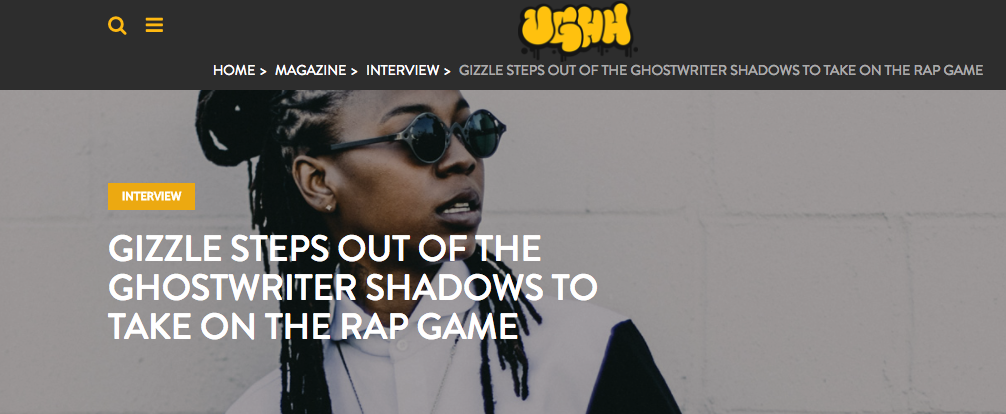
Repost UndergroundHipHop.com: Gizzle Steps Out Of The Ghostwriter Shadows To Take on the Rap Game

June 15, 2017

The studio can be a place of utter mystery for some rap fans.

For many, the idea of going to “the stu” is synonymous with going to the club. It’s a much more exclusive venue, though, directly related to who you know. An elusive cave of luxury, the studio in its most romantic form boasts a scene full of empty liquor bottles, ashtrays full of blunt guts and braggadocios Instagram posts not-so-subtly begging to be taken.

While having a good time is a part of what comes with the territory of being a buzzing musician working in hip-hop, for an artist like Gizzle, the studio is a sanctuary; a second home and a place to get down to work, ironically, in silence.

As a tried and true studio dweller, it’s a place she visits every single day, and quite often, her productive late nights turn into mornings without even a glance at the clock. Having spent the majority of her career sharpening her swords and lending her talents as a songwriter to a high caliber laundry list of industry mainstays, the studio represents sacred ground. However, while she has shined behind the scenes for years, working with the likes of Kanye West, Puff Daddy, Pharrell, Timbaland, Teddy Riley, Nicki Minaj, Snoop Dogg, YG, Travis Scott, Meek Mill, Trey Songz and more, she’s now ready to invite a different element of her artistry to step into the spotlight: her own career as a solo artist.

For those just becoming acquainted with Gizzle, it’s clear she prefers her work to speak for itself. She won’t casually namedrop any of the aforementioned artists into conversation just because she can. I know firsthand, considering we spoke for an hour and I had to drag out names at the tail end of the convo—prying to see if Diddy showed her love on her new project (he did) and ask who else she’s previously worked with encouraged her individual career (many, with Ty Dolla $ign offering her an “I told you so” moment once she finally took the leap). With over a decade in music under her belt and experiencing her favorite artists becoming her mentors, the next step organically presented itself in the form of an on-the-spot creative challenge that evolved into her first solo release.

Releasing her debut project 7 Days in Atlanta further proved for Gizzle that the studio is more closely related to a creative mindset than it is an opportunity to schmooze for social media street cred. That is part of why she’s been able to accomplish as much as she has. After years of making ripples, Gizzle is getting ready to make waves.

Born and bred in Los Angeles, the 28-year-old artist first got her footing living her artistry as a teenager, writing lyrics on her homework and wondering where exactly her pen game could take her next. Now that Gizzle’s long-awaited debut as a solo artist has finally arrived, she’s about to find out.

What made you want to finally release a solo project? Why now?

The anticipation was building for a while, and I didn’t really have a chance to get my message across. I wanted to be able to say the things that I feel can only be said from my voice. While working with so many people and having the blessing to be a part of so many different people’s careers, I’m still essentially helping other people tell their story.

Eventually, I got to the point where I was just going to have to speak for myself and put that same kind of effort and energy into my own product or projects; make my own legacy. I started off by rapping, and I’ve just been rediscovering my love and passion for that. From an artist’s standpoint, songwriting has been so good to me and is such an important part of who I am. I enjoy it so much and I love being able to speak from different perspectives and help people get out whatever their ideas are and their dreams are. But I think it’s very important for me to step in and say things that I always don’t get to say because you can’t always say or do what you want when it’s on someone else’s behalf, you know?

How did the idea come about to create 7 Days in Atlanta?

We know that a lot can happen in a week. A lot can happen in a day. I planted the seed for the idea last Summer, and the reason I was thinking about it and talking about it was because it was something I wanted to do with other artists. Like maybe we can just go somewhere dope and make a whole project out of the trip. I planted the seed and let it sit there for a while, but last December, I was in an interesting place creatively and personally. I was like, “You know what? I’m just going to go to Atlanta for a week and create.”

We literally locked in just seven days straight where we woke up and went straight to the studio. At the end of the week, I realized that this was the same idea I had from six months ago, and I did it without even really thinking about it.

Going through the material, I realized we really had something there and it was bigger than Atlanta. I’m very familiar with Atlanta and I’m comfortable there, so it’s like a second home to me in a lot of ways. Creatively, I just always find freedom there. Not to mention, the food and the people, too. I have a pretty bad addiction to lemon pepper shrimp, and it’s basically all I ate while I was there. I wanted to figure out which place has the best lemon pepper shrimp, and while I was waiting for my food one day I got the idea for “Single And Poppin’” because my friend and I were just joking and catching up. She asked me about my ex; I just answered, “I’m single and poppin’!” We started chanting it at the bar and making it snap. When we got back to the studio, the idea just stuck. It made a lot of sense too.

So, with the songs stemming from a specific experience, how did “Melanin” come together, for one example?

For “Melanin,” that song was a little bit more focused and less spontaneous than “Single and Poppin’.” We had some girls over to the studio, and we got into a little bit of a debate over the Black experience in America. They actually weren’t Black and they were saying the N-word, and I just wasn’t with that. So I told them, “I don’t know if you probably hang with other people where that may be cool, but I’m not into that.” They weren’t, but they were of Middle Eastern descent and I just felt like they didn’t identify with being Black, so I just didn’t understand why they felt the need to say the word so much, you know what I’m saying?

I didn’t want to discourage these girls or leave a bad taste in their mouths, but I never want to sit idly with something that’s not appropriate, especially if I have a chance to educate or help someone get a different perspective. Although I felt a little bit shitty over the situation, since they got mad and felt bad, I just wanted to make a song that could make all people—but specifically my people—feel good when they wake up. I wanted to let people know that it’s okay to be Black, and it’s okay to be proud. We see that dialogue more now, especially with movies like Get Out, but even though it’s more of a conversation, I just wanted to make something that would be a reminder to my people to feel good about being Black. You can feel how personal it is and that’s not just specific to being Black, it’s specific to being proud of who you are and where you come from and take into account your entire history. This song just kind of wrote itself.

For you, how does your environment relate to your creative process?

Because I’m a creative and I work on a lot of different things, in order to make myself a priority, I have to put my own pressure on myself and put that fire under me. I’ll be doing seven days in Denver next, and I’m so excited.

I feel like, of course, you always have to be in the right mind space, but just living life is very much a part of my creative process. If I’m not maxing out every day and doing everything I can to really be living—enjoying myself and having a full life—then it’s hard for me to be inspired. That’s why I’m able to be inspired when I’m traveling, because I love traveling. This will be my first time in Denver, but I know that things are going to come up and it’ll result in really good music. I’m making a conscious effort to create something special, and from that point on, I’ll always have an ongoing connection to that city. Denver and I will always have that little baby we created.

Why Denver?

I picked Denver because it’s a city that’s pioneering in a lot of ways socially, especially with the legalization of marijuana. I feel like it’s just an up-and-coming city. There’s culture there but nobody off the top is like, “Oh I’m going to go make my album there,” so I feel like that’s important. It’s also a place that called me. I’m excited to see whatever it has to offer.

Do you think that there is a pressure to create socially conscious music under Trump’s presidency?

I think if you’re an artist and you’re not making music that reflects the times then you’re doing yourself, your fans, and the culture in general an injustice. Every day that I wake up, my aim is to learn something, to widen my perspective, and to grow as a person. I’m not a conscious rapper, or a backpack rapper or an overly pop rapper. I’m not a preacher. But I do aim to covertly slip some consciousness into my music. If I experience happiness, sadness, love, or injustice, it’s going to be in my music.

Does anything change in your creative process when transitioning from making music for others versus yourself?

What has changed is that I am a bit more selective in the things that I decide to take on. I’m in an interesting place because I’ve been writing songs for so long—primarily in an R&B and a hip-hop space—so I’m trying to do things that challenge me as a writer. That’s easier to do on your own work. When people call me and say, “Hey, Gizzle, what you got for this?” if it’s not something that really excites me, I don’t want to do it. No matter what it does in terms of success or money, if I’m not growing as a person or if I’m feeling like I’m just doing the same thing I was doing last year or even yesterday, I just don’t want to do it. So for me, it’s about finding that balance of doing things that excite me, working with people that I really care for and if I can aide their career in any way, all while challenging myself. I want to grow and get better, so that hasn’t really changed. I have turned down a few things and that can feel really good. Personal legacy has always been number one for me. I want to feel proud of everything that I’m a part of. Doing the 7 Days project is exactly that. It’s something I am excited for and get passionate about every single time. As I grow, it’ll grow. That’s where I’m at.

Being a songwriter and having spent so much time behind the scenes, how is your live performance?

I’ve always been a natural performer, and I love it. The studio is my favorite part, but both are my safe havens. I go to the studio every single day, but putting on a live show is a lot of work in a different way. My live show has definitely gotten better over the past six months alone. I’m just trying to do something that people are going to remember.

I’m most comfortable having my live band, but am working on tailoring the experience the best I can with the resources I have, since you don’t always get to bring a live band with you. It takes conditioning. I have a deeper voice than most people too, so it takes me a little bit of extra time and care to prepare and recover. With 7 Days in Atlanta, I’m performing it in order so it’s been cool to see how it comes to life in the live setting and just coming with that energy. Slowing it down in the middle and then building back up the energy.

What did you learn from your time at SXSW this year?

It’s all about the importance of the live show. There are so many artists performing and every body has their own angle. It’s cool to get down with your peers, discover new talent and see where you fall into the fold. Make new fans along the way and take them on my journey with me. SXSW just fortifies the importance of getting out there, finding a demographic, reaching out to your fans, testing the people and it’s definitely a great investment for a new artist.

For myself, I say that loosely, that I’m a “new” artist. I definitely paid attention to some of the marketing things that newer artists are coming up with down there, so much of it is genius. Everybody doesn’t have a huge budget and you just see people making due with what they have and with a lot of passion. Some people, who didn’t have CDs or anything, would just come up to you and rap. I love that part of the culture. That part of hip-hop is how I first got into the game. I just decided I wanted to rap when I was 11 after a poetry reading I did had people asking for an encore. Whenever that happens in my live show now, it just takes me back and gives me a little confirmation that I am on the right path. So, yeah, that was a moment for me at South By.

With getting your start in music so young, when did you realize this was going to become your career and your life?

I had an aunt that was signed to Snoop Dogg’s [label] when I was like 12 years old, so I got to see that firsthand. I got to see my aunt go from writing raps in my grandma’s house to being on television. So I saw that, coupled with what I felt like was my natural ability and the work that I was willing to do. I always thought it was a plausible thing; seeing those experiences and seeing the growth that I was making just from writing everyday and the response I would get in school. I wrote raps on all my homework so I’d turn in my homework and I’d have to get it back from my teachers, like, ‘hey, my rap is on the back and I need that!’ [Laughs] I’ve always had that kind of encouragement since I was a kid, so it’s always been clear to me that I had a future in music. I’m really grateful for that.

I think because my family has seen that I’m not quitting and I’m not stopping, their respect level has grown for what I do. When I was younger, it’d be like, “So, what college are you going to?” I think as I’ve reached adulthood and accomplished a few things, saying that you’re a rapper at the family reunion isn’t a joke anymore. It’s now all, “that’s my cousin and she raps!”

Is remaining independent an important focus for you right now or would you consider signing with a record label if the fit was right?

I think ownership is important. I wouldn’t entertain a record deal, but I’d entertain a partnership. You can’t do everything by yourself. The goal is to get the music to as many people as possible and to share and spread the message—the love and the light. But owning what you create is very important. I’ve been offered a record deal every year since I was 16 years old, and I haven’t accepted one yet. At this point, I feel like it’s kind of too late, especially with everything that’s available to you now. I’ve been putting my blood, sweat, and tears into this since I was a teenager, so I feel like I should be able to make decisions and be in control of the message. There’s nothing wrong with signing a deal if you have a great label and a good relationship and partnership. For me, it’s always about making sure that I have the choice and the control to say the things that I want to say, and be conscious of the energy that I’m putting out there. The same thing goes with my songwriting. I’ve had chances to be on many different singles that went on to be successful, but for me, personal legacy is everything. I’m not ever going to compromise that. I just want to be able to look back at all of this and be proud of it. That’s why being independent is important for me at least: to be able to show all the business people, the higher ups, and the powers that be what I can do as a businesswoman.

At the end of the day, what’s your main goal?

At the end of this, the goal is always to just be a better human being; to be better than I was yesterday.

Originally published here on UGHH.

Comment

Been a little busy lately, but here's a lil' #BylineDrop!

June 4, 2017

Busy is a blessing! Can't wait to share a more detailed update as to where my pen has taken me lately and what projects I'm working on this summer... but in the meantime, here are some of my recent clips:

10 Rappers Who Have Deleted Their Social Media Accounts, XXLMag.com May 29, 2017.
Interview: Chill Moody May Never Hold Office, But He's Holding Philadelphia Down, UndergroundHipHop.com, May 31, 2017.
Interview: From the Big Screen to the Recording Booth, Page Kennedy is Living His Truths, UndergroundHipHop.com, May 27, 2017.
Interview: From the Trenches of MySpace to Major Stages, the Cool Kids Are Back At It Again, UndergroundHipHop.com, May 15, 2017.
15 Double Disc Albums to Revisit, HotNewHipHop.com, June 3, 2017.
15 Essential Reads for Hip-Hop Fans, HotNewHipHop.com, May 22, 2017.
25 of G-Eazy's Best Guest Verses, HotNewHipHop.com, May 21, 2017.
10 Life Lessons Lil Yachty Can Teach Us, HotNewHipHop.com, May 16, 2017.


Comment
← Newer Posts Older Posts →

Recent Posts

Featured
Jan 1, 2020
Repost REVOLT TV | Each One, Teach One | How the digital era influences artist development, branding and strategic partnerships
Jan 1, 2020
Jan 1, 2020
Dec 12, 2019
#Repost REVOLT TV | Each One, Teach One | A look at streaming’s impact over the past decade
Dec 12, 2019
Dec 12, 2019
Nov 27, 2019
#Repost REVOLT TV | Each One Teach One | 19 times artists expressed gratitude through music
Nov 27, 2019
Nov 27, 2019
Nov 13, 2019
#Repost REVOLT TV: Each One Teach One | Drake, JAY-Z, Snoop Dogg and the business of going green
Nov 13, 2019
Nov 13, 2019